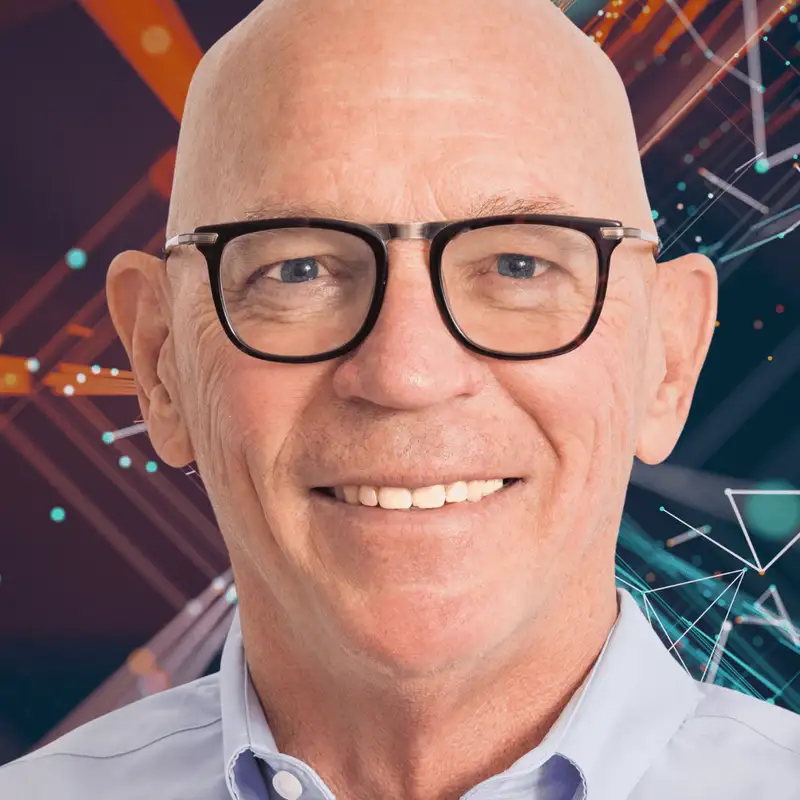
David Kilzer - The Future with AI-Powered Humanoid Robotics
Download MP3According to David Kilzer, the fusion of artificial intelligence (AI) and robotics is the biggest leap for mankind since fire! David has seen dramatic evolution in automation in his 50-year career... influenced by the rise of personal computers, the internet, smart phones, and now AI. He believes that AI-power humanoid robots are a huge game changer, and one that will increase the quality of life for us all.
Imagine waking in the morning and having your coffee made to perfectly suit your taste. Imagine a humanoid robot playing chess with grandpa, or teaching the kids algebra, or folding the laundry or mowing the lawn or blending margaritas! The applications for robots are widespread... from household functions to nursing homes to factories, schools, medicine, and more. They can deliver vaccines in quarantine zones... and can readily access all the world's information. David highlights the future of open-sourced robots... whereby a robot in Japan learns to make sushi rolls, and this skill is uploaded to the cloud and then available for robots on the same platform worldwide. We may all have robots serving us, loaded up with apps for various tasks!
David's company, Strategic Transformation Advisors helps industries tap the great potentials for automation. He is currently working on a major facility in Oregon, where three kinds of robots will be at work... none requiring any space conditioning at all. Robots can work 24*7; they need no breaks or benefits. They are tireless and can do heavy lifting, and can boost productivity, proficiency, and safety. And as more and more automation is developed, costs will fall... only begetting more automation with greater functionality.
There will be adjustments in the transition toward greater and greater automation. Job losses are top of mind, notes David. Goldman Sachs reports that 6 - 7% of the American workforce has already been displaced by AI. Amazon laid off 14,000 workers last year and expects to lay off 30,000 by the end of this year. The implications for jobs are huge... with automation replacing not just manual tasks... but all manner of technical services such as coding, paralegal reviews, and engineering.
The conversation shifts into income tax losses as workers are replaced with machines. David imagines that mechanisms will be needed to address this loss. Should AI be taxed? Should robot leases be taxed? While David offers no solutions, he suggests that clever new means of developing revenues to support government functions may well be needed. He points to Norway's sovereign wealth fund that provides public benefit from oil and gas resources as a model mechanism. How can the abundance that will be created by AI and humanoid robotics be shared for the benefit of all?
The conversation ends with David's bold predictions: AI-power robotics will be prevalent in industry this decade, and will likely be ubiquitous in homes in the 2030s. The pace of automation, and highly intelligent automation, is nothing short of fantastic.
Imagine waking in the morning and having your coffee made to perfectly suit your taste. Imagine a humanoid robot playing chess with grandpa, or teaching the kids algebra, or folding the laundry or mowing the lawn or blending margaritas! The applications for robots are widespread... from household functions to nursing homes to factories, schools, medicine, and more. They can deliver vaccines in quarantine zones... and can readily access all the world's information. David highlights the future of open-sourced robots... whereby a robot in Japan learns to make sushi rolls, and this skill is uploaded to the cloud and then available for robots on the same platform worldwide. We may all have robots serving us, loaded up with apps for various tasks!
David's company, Strategic Transformation Advisors helps industries tap the great potentials for automation. He is currently working on a major facility in Oregon, where three kinds of robots will be at work... none requiring any space conditioning at all. Robots can work 24*7; they need no breaks or benefits. They are tireless and can do heavy lifting, and can boost productivity, proficiency, and safety. And as more and more automation is developed, costs will fall... only begetting more automation with greater functionality.
There will be adjustments in the transition toward greater and greater automation. Job losses are top of mind, notes David. Goldman Sachs reports that 6 - 7% of the American workforce has already been displaced by AI. Amazon laid off 14,000 workers last year and expects to lay off 30,000 by the end of this year. The implications for jobs are huge... with automation replacing not just manual tasks... but all manner of technical services such as coding, paralegal reviews, and engineering.
The conversation shifts into income tax losses as workers are replaced with machines. David imagines that mechanisms will be needed to address this loss. Should AI be taxed? Should robot leases be taxed? While David offers no solutions, he suggests that clever new means of developing revenues to support government functions may well be needed. He points to Norway's sovereign wealth fund that provides public benefit from oil and gas resources as a model mechanism. How can the abundance that will be created by AI and humanoid robotics be shared for the benefit of all?
The conversation ends with David's bold predictions: AI-power robotics will be prevalent in industry this decade, and will likely be ubiquitous in homes in the 2030s. The pace of automation, and highly intelligent automation, is nothing short of fantastic.